

What to Put in a Morning Basket for Teens (Our Lunch Crate Favorites)
In my last post, I shared how our homeschool morning basket eventually turned into what we now call our Lunch Crate—basically circle time for teens.
But that usually leads to the next question:
What do you actually put in a morning basket for teens?
The good news is that this part is easier than you might think. Over the years we’ve found a handful of simple things that work really well for teens—things that spark conversation, introduce interesting ideas, and make the middle of our homeschool day something we all look forward to.
I’ve also collected my fair share of “ohhh… this looks fun” resources along the way, and the Lunch Crate has become the perfect place to actually use them.
Today I’m sharing some of the things that have worked especially well for us.
This post contains affiliate links. Please see my disclosure page for more information.
Read-Alouds
One of the easiest things to include in a morning basket for teens is a good read-aloud. Even older students enjoy being read to, especially when the books lead to interesting discussions. Over the years, we’ve discovered a mix of classics, modern favorites, and biographies that work beautifully in our Lunch Crate.
- Biographies – Short, compelling chapters make them perfect for a 10–15 minute read, and they always inspire conversation. We enjoyed several from YWAM, and the Who Was series.
- Classics – We didn’t read a ton of classics, but a few gems like Call of the Wild, Animal Farm, and The Adventures of Tom Sawyer became favorites in our Lunch Crate.
- Modern Favorites – Holes, Mr. Lemoncello’s Library, Wonder, and whatever I had in my PaperPie stock were all hits.
- Nonfiction – Short nonfiction reads are perfect for quick bursts of learning and often spark longer discussions. A couple of our favorites include The Story of Inventions and any of the 100 Things to Know About… books.
Tips for Read-Aloud Success
- Pick short chapters or segments so the reading fits into 10–15 minutes.
- Rotate genres – fiction one day, biography the next, nonfiction another.
- Everyone participates – let teens read aloud or summarize a section—they engage more when they have a role.
- Book vs. Movie Comparisons – Watch the movie version after finishing a book and compare the differences. Teens love spotting what changed, and a simple comparison guide can turn it into a fun discussion. For a complete, one-year English course or high school elective, check out Movies as Literature.
Bible Memory & Devotions
Another natural fit for our Lunch Crate is a short time in God’s Word. While devotionals can be helpful, I’ve found that some of our best conversations come simply from reading the Bible itself and spending time memorizing Scripture together.
The Bible encourages us to “give attendance to reading” (1 Timothy 4:13), and the Lunch Crate has been a simple way to build that habit into our day. A few things we like to include:
- Bible Memory – We choose a verse or short passage and work on it together for a week or two.
- Reading Scripture Together – Sometimes we simply read a short passage and talk about it. Teens often notice things I miss, and their perspective always adds to the discussion.
- Bible Trivia – Occasionally we mix things up with Bible trivia questions or quick quizzes. It’s a fun way to review stories, people, and places from the Bible.
- Occasional Devotionals – While we don’t rely on them heavily, a good devotional can sometimes help guide conversation or introduce a new topic.
Tips for Keeping It Simple
- Choose short passages or a few verses rather than long readings.
- Let teens take turns reading aloud.
- Keep the conversation natural– sometimes a single question leads to great discussion.
Current Events & Interesting Topics
Another thing we enjoy including in our Lunch Crate is a quick look at what’s happening in the world. Teens are naturally curious about current events, and even a short news segment can lead to thoughtful discussions about history, culture, and worldview.
Two resources we’ve especially enjoyed are CNN 10 and World Watch. Both present news in a format that’s easy to understand, and they usually run around ten minutes or so—perfect for a Lunch Crate break.
Even a few minutes spent discussing current events can help teens develop critical thinking skills and a broader understanding of the world around them.
Tips for Including Current Events
- Keep it short and simple—a 5–10 minute news segment is plenty.
- Ask what your teens think about the topic.
- Pull out a map or atlas to locate places mentioned in the news.
Brain Games & Quick Thinking
Not everything in our Lunch Crate has to be serious. Some days we keep things light and just play a quick thinking game. Sometimes a little laughter and friendly competition is exactly what our homeschool day needs. A few of our favorites include:
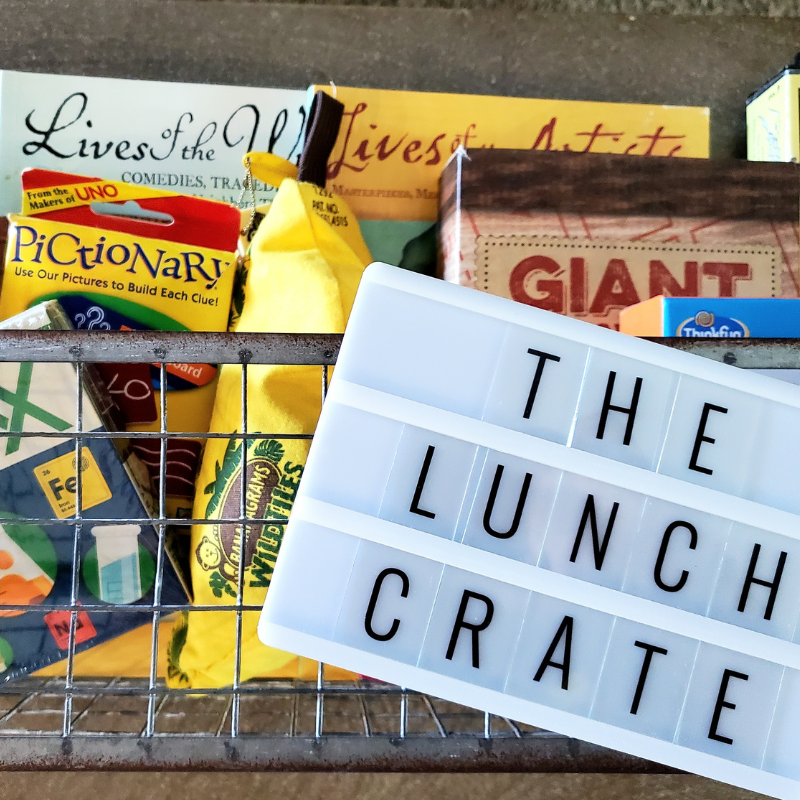
- TENZI – a fast-paced dice game that gets everyone engaged immediately.
- Professor Noggin’s Card Games – fun trivia-style cards that cover topics like history, science, and geography.
- Word games – anything that challenges vocabulary or creative thinking is usually a hit with teens – we’ve enjoyed Wordsmithery, Bananagrams, and Last Letter.
Tips for Using Games in Your Lunch Crate
- Choose quick games that take 5–10 minutes.
- Rotate through a few favorites so things stay fresh.
- Let teens teach or introduce a game they enjoy.
Life Skills
One of the things I love most about our Lunch Crate time is that it gives us space to practice real-life skills that don’t always fit neatly into a textbook.
These are the kinds of things teens will actually use in everyday life—but they’re often easy to overlook in the middle of academic subjects. Some simple ideas include:
- Cooking Skills – Trying a simple recipe together, learning basic kitchen techniques, or talking through meal planning. Two great resources I’ve used are Eat Your Way Through the USA and Eat Your Way Around the World to combine geography with food!
- Budgeting Basics – Looking at how to plan a grocery budget, compare prices, or talk through real-life expenses.
- Communication & Social Skills – Practicing introductions, writing thank-you notes, making phone calls, talking through job interviews, or discussing how to handle real-life situations teens will eventually face as adults. Honestly, this is one area where I sometimes wish I had been more intentional. These skills matter, and even a few simple practice moments can help teens feel much more confident stepping into the adult world.
- Household Skills – Things like organizing a small space, planning a weekly schedule, learning how to sew on a button, or tackling small repairs around the house (tightening a loose screw, fixing a wobbly chair, or replacing batteries).
Oftentimes the most valuable lessons aren’t found in a textbook—they’re learned in everyday life.
Tips for Including Life Skills
- Keep it short and practical.
- Focus on skills teens will actually use soon.
- Let them participate or demonstrate, not just listen.
Seasonal Activities & Fun Learning Extras
One of the most enjoyable parts of our Lunch Crate is adding in a few fun or seasonal learning activities. These are the kinds of things that don’t need to take long but add variety to the day.
Sometimes it’s something simple like watching a short documentary, looking at a famous painting, or reading a poem together. Other days we might talk about a historical event that happened that week or try a quick activity tied to a national or quirky holiday.
Ideas like these work especially well in a morning basket for teens (or in our case, a Lunch Crate) because they keep learning fresh without adding a lot of extra planning.
In fact, I share a monthly roundup of national days that work well for homeschooling, along with ideas for how you can use them in your homeschool. It’s a simple way to sprinkle a little fun and curiosity into your school days throughout the year.
And if you enjoy planning ahead, I also created National Days planning pages for the entire year that make it easy to keep track of the ones you want to use.
Easy Ideas to Try
- Watch a short educational video or documentary clip
- Read a poem together
- Look at a piece of famous art and talk about it
- Explore a fun national or seasonal day

At the end of the day, a Lunch Crate—or a morning basket for teens—doesn’t have to be complicated. A few good books, some interesting conversations, and the occasional fun activity can turn an ordinary lunch break into one of the most enjoyable parts of your homeschool day.
If you’d like an easy way to plan your own, I’ve created a free Lunch Crate Ideas Cheat Sheet with quick categories and prompts you can mix and match anytime.
Grab the Lunch Crate Ideas Cheat Sheet and other Freebies here
It’s a simple starting point for creating your own shared learning time—whether you stick with a morning basket or create your own version like our Lunch Crate.
Because a little shared learning in the middle of the day can turn an ordinary lunch break into something pretty special.


