

Don’t Google Everything: Why We Still Need Reference Books
We live in a world where we can find the answer to almost any question in a matter of seconds.
What’s the capital of a particular country? Google it.
What does a word mean? Check the dictionary app.
Who invented the telephone? Ask Siri or Alexa.
How far is the moon from Earth? You know the drill.
There is something pretty amazing about having all of that information available at our fingertips. I use the internet for a lot of things, and I have no desire to go back to the days when finding an answer meant digging through an encyclopedia for twenty minutes! But there is something I still want my children to know how to do:
Find an answer without immediately reaching for a screen.
That’s one reason I’ve always loved having a reference shelf in our homeschool. I’m not talking about another shelf filled with books that look impressive but never get opened. Remember that expensive set of 1980-something World Books? I’m talking about a shelf filled with books that children can actually use—dictionaries, thesauruses, encyclopedias, atlases, field guides, science references, Bible references, and all sorts of wonderfully interesting books.
Because while information is everywhere, knowing how to find, understand, and evaluate information is a skill—and I think it’s worth teaching.
This post contains affiliate links. Please see my disclosure page for more information.
Why Reference Books Still Matter in a Digital Homeschool
Years ago, I had an interesting experience while looking up the definition of an ordinary word.
The word wasn’t questionable or unusual. It was just an ordinary word. Yet one of the first results presented to me online was a definition that was inappropriate and completely unrelated to what I was actually looking for. And that experience reminded me of something important:
A search engine doesn’t know who is doing the searching.
It doesn’t know that your eight-year-old is looking up a vocabulary word for school. It doesn’t know that your middle schooler is researching a science topic. And it also doesn’t know that you would prefer a child-friendly definition rather than the first thing someone happened to post online.
And you don’t necessarily have to go looking for inappropriate material for it to appear.
I’m not saying we should never use the internet, but I don’t want “Google it” to become the only research skill they ever have. I want them to know that there are other ways to find information. Perhaps most importantly, I want them to understand that the first answer they find isn’t necessarily the best answer.
A Reference Shelf Teaches Research Skills
One of the things I love about physical reference books is that they teach skills almost without children realizing they’re learning them.
A dictionary teaches alphabetical order, guide words, pronunciation, definitions, and multiple meanings.
A thesaurus teaches children to think about word choice rather than simply accepting the first word that comes to mind.
An atlas teaches them how maps work, how to use a legend, how to find places, and how geography connects people and events.
Even an index teaches them how to locate specific information without reading an entire book from beginning to end.
These are all research skills—and they’re useful whether a child is holding a book or sitting in front of a computer.
What Belongs on a Homeschool Reference Shelf?
There isn’t one perfect list of books that belongs on every homeschool reference shelf. Your shelf should reflect the ages, interests, and needs of your family.
Our shelf has changed quite a bit over the years, too. Some books have been used constantly, some only occasionally, and some have simply been too good to get rid of—which is where I find myself at this stage of life!
Here are some of the categories that have earned a permanent place on our shelf.
Dictionaries and Thesauruses
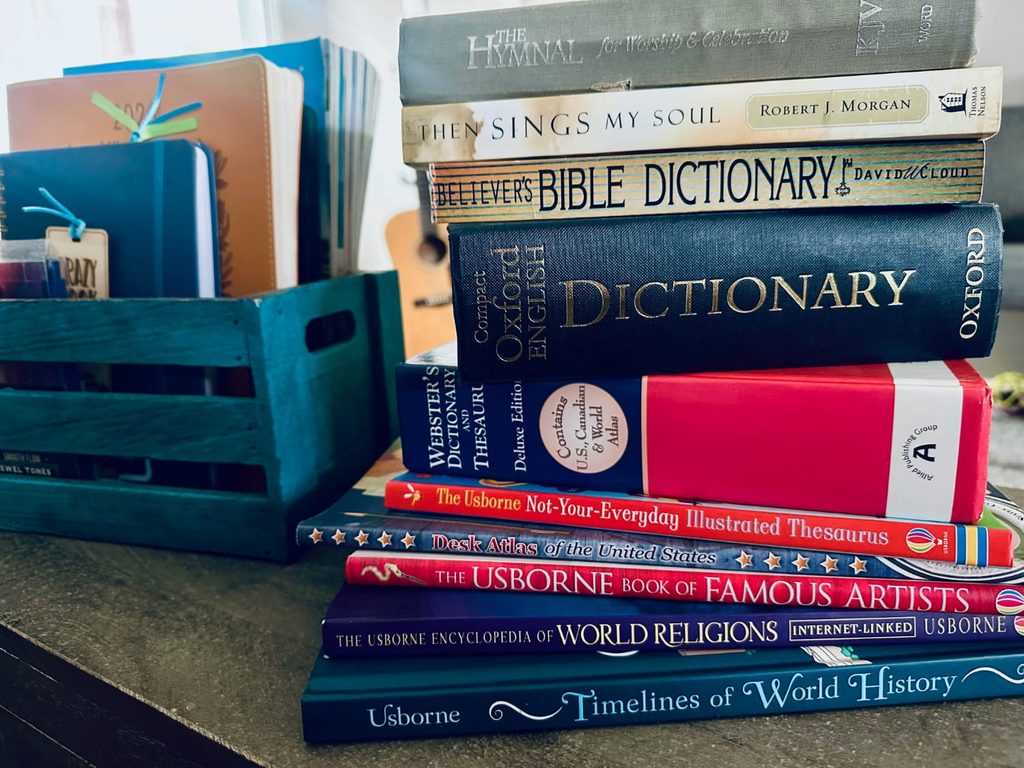
A good dictionary is one of the first things I’d put on a homeschool reference shelf. We have a Webster’s Dictionary & Thesaurus, an Oxford English Dictionary, and an illustrated children’s dictionary that we’ve used over the years.
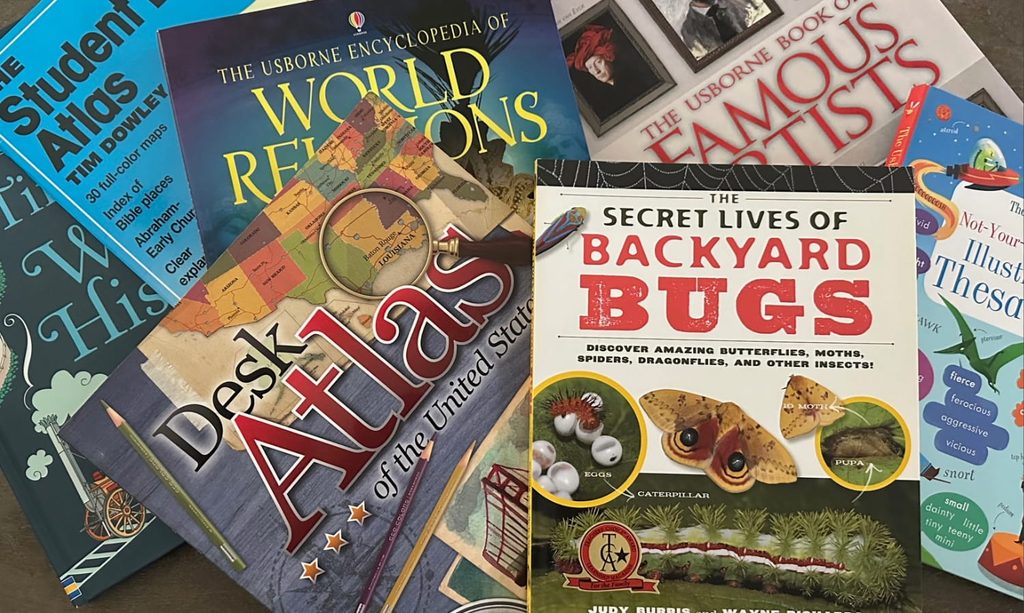
I also love the Usborne Not Your Everyday Illustrated Thesaurus. It’s organized by theme rather than alphabetically, which makes browsing it especially fun—and I often find myself using it too!
Grammar and Writing References
A grammar reference book is another one of those resources that is worth keeping around even after a child has technically “finished grammar.”
Nouns, verbs, clauses, quotation marks, punctuation—sometimes you just need to look something up. And yes, even after all those years of homeschooling, I still do!
Encyclopedias
I have always been a fan of children’s encyclopedias, and they’re some of my favorite homeschool reference books. They’re wonderful starting places when a child has a question—or when they don’t quite know what question they want to ask yet.
A good encyclopedia takes a large subject and breaks it into manageable pieces. We have enjoyed several Usborne encyclopedias over the years, and I recently found a new favorite! It’s for younger children, and it’s actually seven books rolled into one—with an index! There are tons of illustrations and bite-sized pieces of information, which makes it easy to follow a rabbit trail.
Atlases and Geography Books
Every homeschool needs maps. At least, that’s my opinion! I love maps!
A good atlas can make history and geography come alive in a way that a paragraph simply can’t.
I especially love our Desk Atlas of the United States, with its double-page spread for each state, and the Usborne Geography Encyclopedia, which is packed with maps, people, cultures, and fascinating geographical information.
Science References and Field Guides
This category can go in so many directions depending on your child’s interests.
Animal books, insect guides, astronomy books, rocks and minerals, plants, weather, the human body, microscopes—you really can’t go wrong. There’s something especially satisfying about being able to take a science question and pull down a book instead of immediately searching for a video.
Bible Reference Books
Our reference shelf has always included Bible reference materials: Bible atlases, Bible dictionaries, and books about the people and places of Scripture have all been useful supplements.
And Then There Are the Unexpected Books
Not everything on a reference shelf has to fit neatly into a category like dictionary, encyclopedia, or atlas. I have kept a hymnal on our shelf for years—the one from the church where I grew up. It isn’t a typical homeschool reference book, but I love having it there.
Maybe your shelf will have a special cookbook that is referred to time and time again. Maybe it’s a gardening book, a local history book, or something about your family’s heritage.
The best reference shelf is one that makes your children curious.
You Don’t Have to Buy Everything New
Please don’t look at this list of reference books and think you need to go shopping. You don’t!
Start by looking around your own house. You may already have more reference books than you realize. Check the shelves, dig through those boxes of old homeschool materials, or ask friends or relatives if they have old atlases or encyclopedias tucked away.
Don’t overlook library book sales, thrift stores, used bookstores, and yard sales. Some of the best reference books I’ve owned have cost only a couple of dollars.
Of course, some reference books age better than others. A dictionary or thesaurus can stay useful for years, while books about medicine, technology, or current events may need to be checked against newer information. That doesn’t mean you can’t use an older book—it just means it’s good to know when a second source is worth checking.
Build your reference shelf slowly.
Start with a dictionary or an atlas. Add an encyclopedia when you find a good one. Then follow your children’s interests. A bird lover might need a field guide. A budding astronomer might need a book about space. Over time, your shelf becomes a reflection of your family and your years of learning together.
Don’t Just Own Reference Books—Teach Your Children to Use Them
This might be the most important part. A shelf full of wonderful books doesn’t accomplish much if nobody knows how to use them.
Show them how to find guide words in a dictionary, use an index, read a map legend, find a topic in a table of contents, or use a glossary. These little skills can seem obvious to us because we’ve been doing them forever—but they’re worth showing a child how to do.
So every once in a while, instead of saying, “Go Google it,” try saying:
“I don’t know. Let’s look it up.” Let them find the word. Look up the place. Use the index. Follow an interesting fact down a rabbit trail. It doesn’t have to be another school assignment. In fact, I’d rather it feel like a game.
Eventually, the goal is for your child to see a question and think, “I know how to find that out,” before grabbing a phone every time. And that’s really the whole point of having a reference shelf.
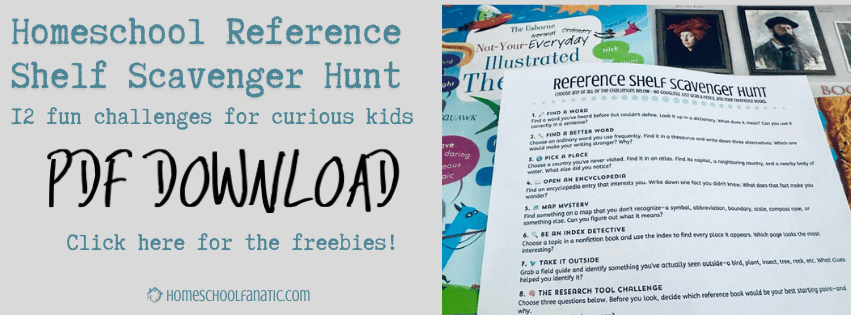
Because those skills are easy to overlook, I put together a little Homeschool Reference Shelf Scavenger Hunt to help you get started.
It’s not a list of books to buy. It’s simply a collection of fun, low-pressure challenges that give kids a reason to open the reference books you already have.
A Reference Shelf Full of Possibilities
Your reference shelf doesn’t have to look like mine. It doesn’t have to be big or filled with every book someone says a homeschool family needs. Maybe yours has five books. Maybe it has twenty-five.
I’ve finished homeschooling, but the reference books are still here – like a little collection of our homeschool years! They’re here to stay. Have you got a reference shelf at your house? I’d love to know what’s on it!



This is such a good post and so timely! I can vouch for the fact that definitions and also websites that were once trusted and solid, can change quickly in today’s world. A real book will stay the same!